Chance is but a name for Law not recognized
The sixth Hermetic Principle is that of Cause and Effect. The Kybalion, which is the source of the Hermetic Principles says, “Every Cause has its Effect; every Effect has its Cause; everything happens according to Law; Chance is but a name for Law not recognized; there are many planes of causation, but nothing escapes Law.”
As a lawyer, astrologer, and systems enthusiast (sometimes aka control enthusiast) this is one of my favorite Hermetic principles. No dis intended at the other principles, though. They’re all lovely.
The Hermetic wisdom behind the principle of cause and effect says that all of our actions and inactions, down to the level of our thoughts, have impacts. This can be overwhelming to think about at first, but is ultimately empowering.
For example, imagine sitting on a couch under a blanket and thinking about someone you love. Your mind fills with thoughts of what you like about them, your body relaxes, and you may even decide to send them a little note. Your little love note makes their day better (or worse depending on their internal state), and then they express how they are feeling to their dog, and so forth.
And, at the same time, while you are sitting on the couch thinking about them, you are not doing 1000 other things. So, the inaction also has impacts. You are not robbing a bank, you are not protesting fascism, you are not learning to speak Japanese.
We understand our thoughts, feelings, and actions most clearly by looking at the external results (otherwise known as consequences or effects) we have. When we can take responsibility for the results we have, we can be most empowered and then look at how to get results that are in better alignment with who we are.
Legal Cause and Effect. This principle is solidly baked into the legal system in the US, and I imagine it is central to most other legal systems, though feel free to tell me if you know of a system that does not center cause and effect. However, the ways we handle this in the legal system is also based on exceptionalism and hierarchy, so we both nominally center cause and effect, and then typically deny the system’s participation in the cause and effect.
In the law, causation is a central component of proving any crime or civil violation, down to the level of thoughts (or, “mens rea” as you may know from Legally Blonde). For example, in proving a violation of law occurred, we have to prove that the harm happened (the effect), and that the violation of law was the cause of that harm. We also have to prove the level of intent the person had. Were they ignoring the rules or were they violating the rules intentionally, knowing what the rules were? That makes a difference in how the law handles a situation.
What the legal system generally does not evaluate is its own cause and effect. So, most people within the legal system are just “doing their job,” which is processing paperwork, talking on the phone, or making and evaluating arguments in court. Most judges have a sentencing docket during their day in which they evaluate recommended criminal punishments. On any given day, a judge and lawyers may send a handful of people to live in a cage for a certain amount of time. But, because the intent of the judge and lawyers is to follow the system, we call that laudable, while we call someone who puts other people in cages outside of the system a criminal and even a human rights violator.
In some ways, we justify effects if they live within a system that we do not justify outside of a system, although we are still a cause or the cause of that effect.
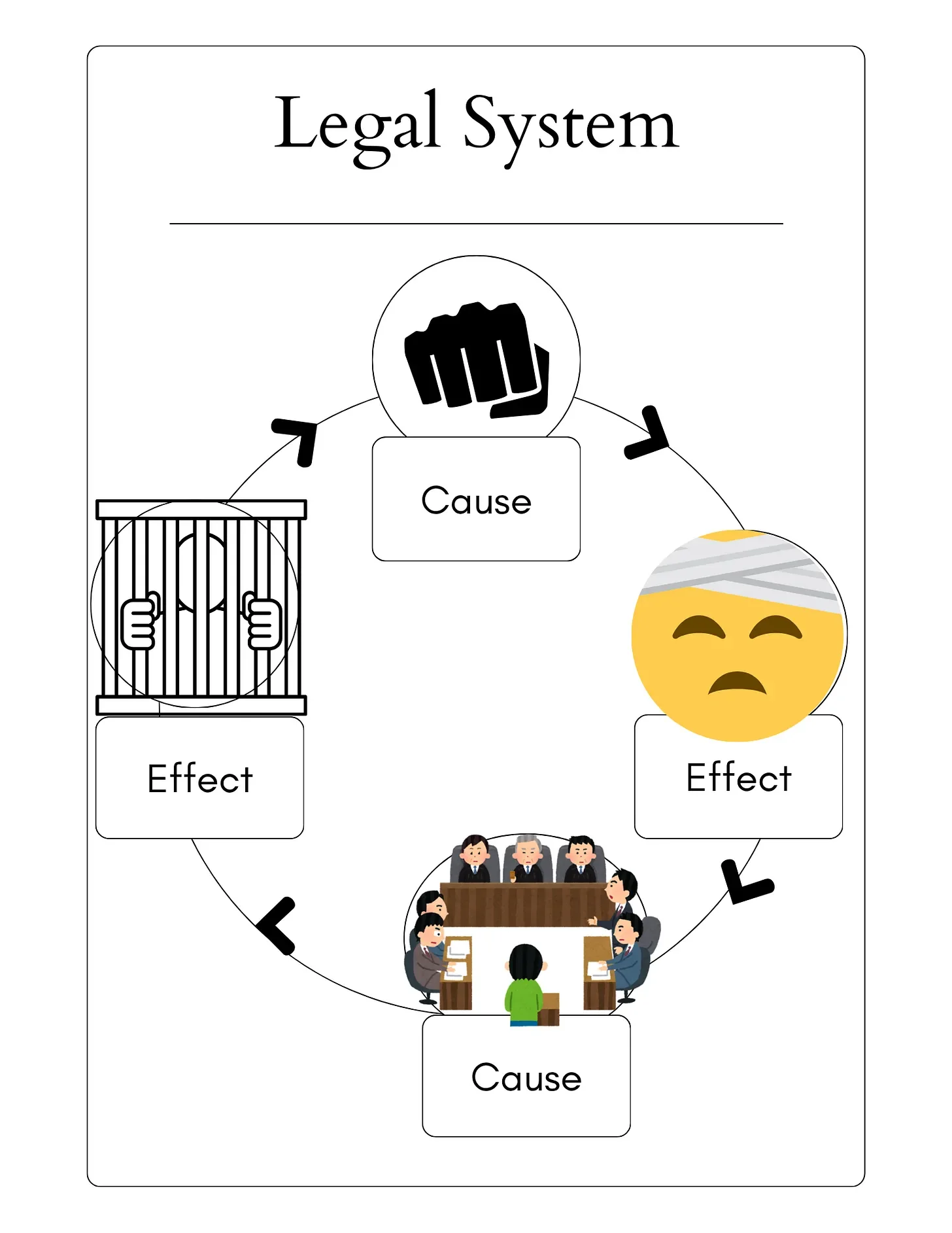
Image showing a cycle of harm in the legal system. One person causes harm, then the system causes harm and the cycle repeats.
In this way respectability culture and hierarchy give us cause and effect blindness. And, at the same time, what do we do with people who are routinely causing harm in order to decrease harm and increase community safety, which most of us want? If we are more honest about cause an effect we can form a better answer to that, and in many areas and systems we already have. For example, based on watching cause and effect we know that access to medical and mental health treatment and housing significantly reduces crime and other harms, while prison often increases risk of harms. So, if we really want to make communities safer, cause and effect honesty is a crucial part of that.
Cause and Effect in Astrology. In astrology, we mostly talk about correlation, rather than causation, but astrology provides a personal framework for talking about cause and effect, versus a the social framework that the legal system provides. So, astrology is the study of the correlation between celestial events and earthly or personal events. There has historically been a debate over whether astrology says the stars “cause” earthly events or whether the stars are a map or reflection of fate, like a mirror that provides impressions of the progression of time, rather than reflecting an exact image of the present. Chris Brennon’s Hellenistic Astrology course goes into this concept in much more detail, so check that out if it is an interesting topic to you.
On a personal level, astrology, and specifically the signs of the zodiac, provide a map of our own inclinations that start a conversation about our personal causes and effects and whether they are in alignment with who we truly are and who we want to be.
As a personal exploration, look at your own astrological natal chart (go to astro.com to get it if you don’t already have it) and find out where the signs are in your chart and how emphasized they are. While you might have heard that you are an “Aries,” meaning your sun is in Aries, a true natal chart reading includes all of the signs with specific placements and emphases regarding them. So, because we all have all of the signs present in our chart, and in that way we are all a unique little universe or mirror of the larger universe, we can look at our own charts to be more intentional about our internal and external causes and effects.
I may go into these in more depth for each sign, but below is a brief overview of each sign in terms of how they participate in cause and effect on a basic level.
When you look at the components that make up who you are, you can better understand yourself as a Cause in life, rather than as simply an Effect of external circumstances or upbringing.
This is a basic overview of the signs as they engage with cause and effect, though this is by no means comprehensive.
Aries. Aries is an active (yang), cardinal, fire sign. This means that if you think about the element of fire, you understand something about Aries. “Cardinal” means the sign is associated with leading.
Taurus. Taurus is a receptive (yin), fixed, earth sign. This means that if you think about the element of earth, you understand something about Taurus. Within earth, Taurus is somewhat like a garden bed ready for planing. A “fixed” sign is, like it sounds, associated with rigidity and not moving.
Gemini. Gemini is an active, mutable, air sign. If you think about the element of air, you understand something about Gemini. “Mutable” means that it changes and shifts flexibly with its surroundings.
Cancer. Cancer is a receptive, cardinal, water sign. If you think about the element of water, you understand something about Cancer.
Leo. Leo is an active, fixed, fire sign.
Virgo. Virgo is a receptive, mutable, earth sign.
Libra. Libra is an active, cardinal, air sign.
Scorpio. Scorpio is a receptive, fixed, water sign.
Sagittarius. Sagittarius is an active, mutable, fire sign.
Capricorn. Capricorn is a receptive, cardinal, earth sign.
Aquarius. Aquarius is an active, fixed, air sign.
Pisces. Pisces is a receptive, mutable, water sign.
If you look at each placement in your chart you can develop an overall impression of whether your chart emphasizes cause and effect in terms of action or receptivity, as well as looking at your flexibility, fixedness, or instigation and your elements.
If your chart primarily emphasizes receptiveness, then how you receive is an area to examine to see if you are in alignment in terms of cause and effect, and likewise if your chart emphasizes action.
There is no one right way to be human or to handle cause and effect, except that the more in alignment we are with our intention and who we truly are, the better our cause and effect will feel to us. Astrology is one system for examining what is in our control and what is outside of our control in that conversation.