Inanna Shadow Ritual
A journaling ritual exercise
Inanna is the ancient Mesopotamian name for the Goddess of Heaven and Earth, and her story focuses on the journey to the Underworld. Inanna was drawn to the Underworld, ruled by her sister, Ereshkigal, because she heard whispers that in visiting the Underworld, she would learn and grow. Ereshkigal’s husband, whom Ereshkigal loved dearly, had also died, and although none who enter the Underworld live, Inanna wanted to witness his funeral rites.
As Inanna prepared to descend, she armored up, gathering her lapis lazuli armor and jewelry around her, and told her faithful servant that if she did not return in three days, to petition the gods to save her from the Underworld.
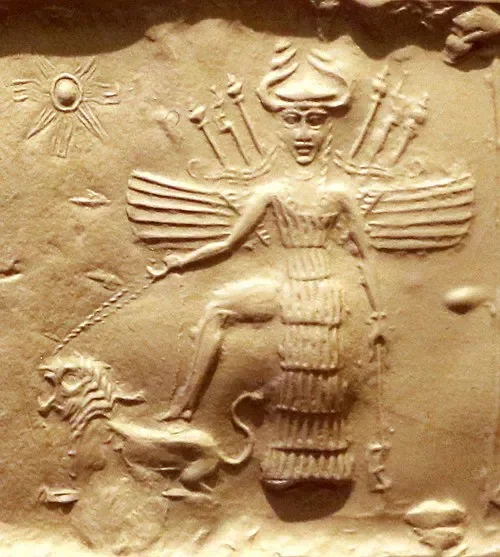
(An ancient Babylonian carving of the Goddess Ishtar, a later version of Inanna, showing her ready for battle with her lion and eight pointed star symbol.
In order to enter the Underworld, Ereshkigal required Inanna to abandon her armor and jewelry at the gate, stripping Inanna of power. When Inanna arrived, powerless and naked, into the throne room of the Underworld, the judges of the underworld surrounded her and condemned her. Ereshkigal turned the eye of death upon Inanna and Inanna died. They hung her corpse on a hook on the wall.
Three days passed, and Inanna’s faithful servant petitioned the gods to save her from the Underworld. Only the God of Wisdom, Enki, would intervene. He fashioned two nonbinary beings to go to the Underworld to save Inanna. When they arrived, they found Ereshkigal still mourning her husband, wailing at the pain of her loss. The beings sat with her and mourned with her. When she wailed that her heart was broken, they wailed with her that their hearts were broken too.
Because of their empathy, Ereshkigal allowed them to revive Inanna and take her from the underworld. But, as they were leaving demons attached to Inanna and told her they would need someone to replace her. The Underworld would not allow anyone to leave without a replacement. The demons returned to Inanna’s palace with her, and they came upon her faithful servant. The demons told Inanna she could be released and they would take the servant in her place. But, Inanna saw the servant despondent at Inanna’s loss, in dirty mourning garments, and awaiting Inanna’s return after having petitioned the gods to intervene. Inanna refused to let them take her faithful servant in her place.
The group approached loyal friends and servants throughout the palace, but Inanna would not let them take those who had been loyal to her and mourned her absence. Finally, they came upon Inanna’s husband, who was lounging in fine clothes and indulging in a buffet while she suffered in the Underworld. Inanna allowed the demons to take him in her place because of his lack of empathy.
This is one of the translated original versions of the story.
Inanna and Shadow. The story of Inanna tells the allegory of a descent into shadow or into the exile parts of human experience or human psyche. We use the term “shadow” to refer to parts of ourselves, of our psyche, that we are not willing to accept or that we think are wrong or bad. In Internal Family Systems Therapy, these parts are also called “exiles.” So, for example, if you were too loud or opinionated or emotional as a child, you may have been told you should be smaller. The loud, opinionated, or emotional part of you would be shut down and put into “shadow” or exiled.
While the hero’s journey told from a male perspective often focuses on a triumph of the will and embracing inner power over an external foe, Inanna’s story is one of delving into the depths of experience in order to grow. It is a story of the importance of empathy.
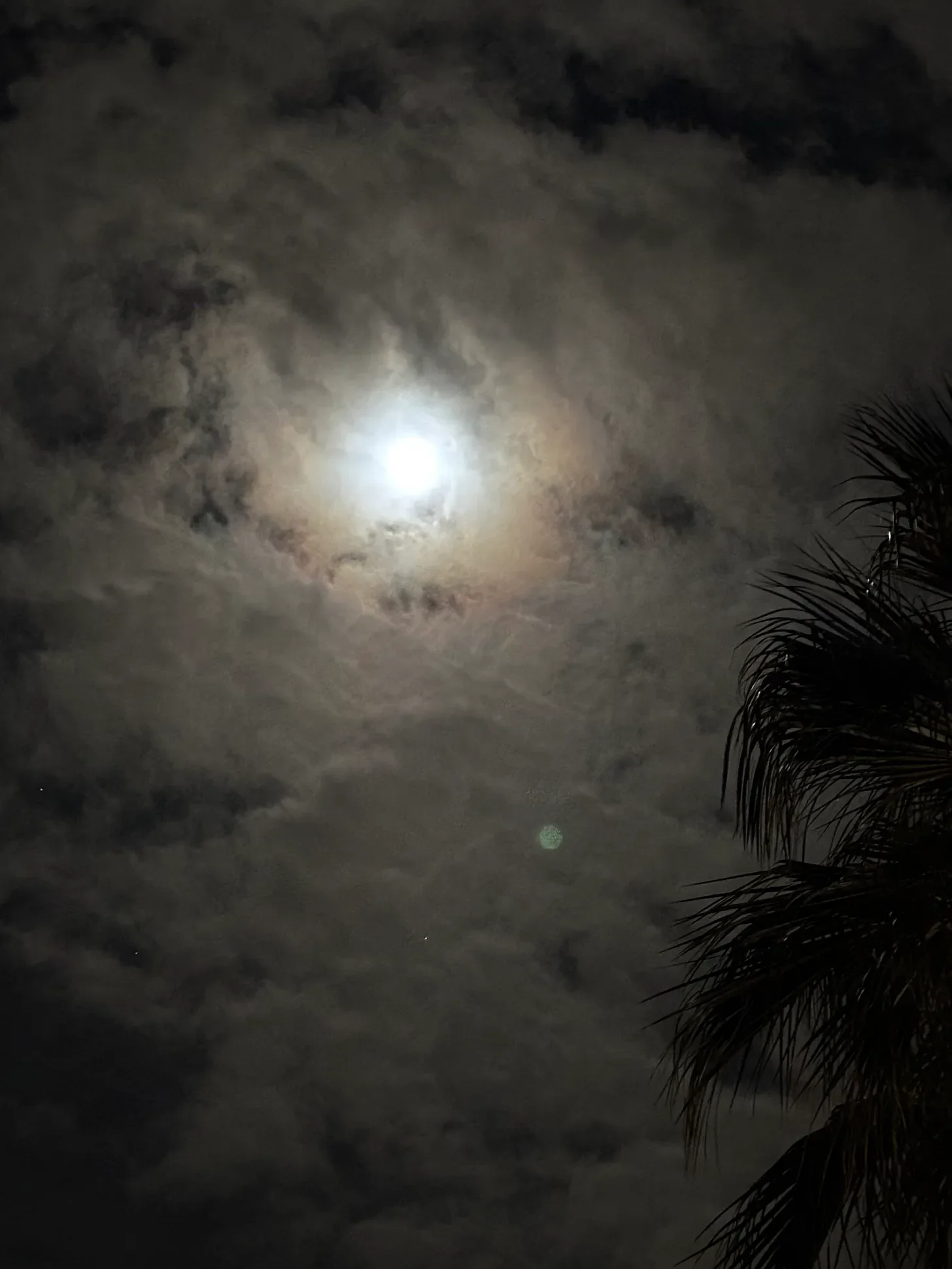
(Photo of the Cancer full moon January 2, 2026)
Pema Chodron tells a story, and I believe it is in the lecture Awakening Compassion about a man being bullied in a bar. In the story, he has a new leather jacket he is proud of, and a group of bullies take it from him. The man feels shame, and then as he is feeling shame, he realizes that there are millions of other people in the world also feeling shame. Although shame appears as a disconnection from the people around him, as badness, or otherness, actually it connects him to all of humanity.
Nobody escapes human existence without feeling shame, terror, loss, loneliness, and other painful emotions. Nobody escapes the underworld of human experience. In fact, Inanna, the Goddess of Heaven and Earth, knows she will grow from this, and she does. She learns what it means to be powerless and bereft, relying on those who are loyal to her. And she learns what it means to be supported.
She also learns the value of empathy.
Inanna and Empathy. It is through our own experiences of painful emotion that we learn to understand, on some level, the experience of those around us. Inanna approaches her mourning sister, saying that she wants to observe the funeral rites of Ereshkigal’s beloved husband. She wants to watch the show.
Anyone who has experienced grief will understand Ereshkigal’s reaction to this voyeuristic attitude. One time, I was in the hospital, waiting for my father to get out of a very serious emergency surgery, and people my family knew from church came to the hospital. I guess they thought they would keep us company? They started chatting with each other, talking about what they were going to have for dinner, and I could not wrap my brain around the fact that they had invaded our sacred family space to talk about their own personal interests. They wanted to watch. If I had the eye of death, I would have turned it on them. And I have seen those experiences over and over.
It is empathy that teaches us how to sit at a funeral and mourn with the mourners, like the nonbinary saviors do in Inanna’s story.
When Inanna returns from the Underworld, she learns who supported her and who feasted during her suffering. This is another empathy lesson.
Inanna and the Present. Many of us have been on an underworld journey or journeys, perhaps throughout the past year and perhaps over the past decade or longer. As I am writing this, it is early in January of 2026, and we are in the wintertime, the time of Inanna in the Underworld. In the Spring, she returns to earth as the sun returns. There is seasonal and personal correspondence with the story as I am writing it.
I am returning right now from a literal journey to help a family member who is in mourning and was going through a surgery. I spent the past months in Texas, which for me is an Underworld, contrary to my natural inclinations and affinities.

(Photo of Monument Valley I took on my journey into the Underworld.)
But, in many ways this has been a year of waking up to the ways that the world around us is harsh and unforgiving, especially to people with exploited identities. What do we do with the understanding that some people will never support us? How do we return to life after our journey into nakedness, powerlessness, and depths of isolation?
The story of Inanna is redemptive because through her journey, not only do we learn empathy and that there is value in sitting with pain, but also we return with freedom to leave behind unsupportive and exploitative relationships. While there is pain and grief in this, there is also freedom and renewed connection with our closest accomplices.
Inanna Journaling Ritual. Get out a piece of paper, blank document, or journal. If you prefer voice notes, open a voice recording.
If you have it, pull out some Lapis Lazuli, and put it near you or hold it in your hands.
Journal about the following:
What possessions do you have that make you feel powerful? This could be clothing, jewelry, property, household items, or anything else that reminds you of your power. How do you feel when you are around these items? Why? What resonates with you about them?
When did you recently hear of someone else mourning a loss? How did you interact with that situation? What judgments do you have about how you handled this or how the other person handled this? What “shoulds” come up for you about how either of you should have handled this?
Have you ever mourned a loss? This could be a death or even a disappointment. How did you feel? What judgments did you have, or do you have now, about how you should feel?
Imagine your guides, angels, and ancestors surrounding you (these are only comforting beings who have your best interests at heart like the nonbinary saviors in Inanna’s story). They offer you only compassion and empathy and they feel the pain of your loss with you. What messages do they have to offer you?
For each judgment you listed, write them down on a piece of paper, but before each sentence, write “I am human, and humans sometimes [judgment]. I love myself when I [judgment].” So, for example, if Inanna were a human, she might write, “I am human, and humans are sometimes voyeuristic instead of empathetic. I love myself when I am voyeuristic.”
Light a candle in honor of the return of Inanna to the heavens, and (only if you can do it in a fire safe way!!!) say each statement out loud as you burn them. If it is not safe for you to burn them, you can still read them out loud and tear them up or put them in water. So, take each statement, offer yourself love around the judgments in order to integrate the shadow or exile, and release each one. These are spaces where we offer ourselves kindness and empathy, not spaces where we punish ourselves.
This can be an intense process, and I recommend processing shadow or exile parts work with a therapist. The National Suicide Hotline is also available at 988, and I absolutely encourage you to access that resource if your thinking has turned against you.
Ultimately, Inanna had to release her ego, symbolized by her jewelry and armor, in order to go through the death and rebirth process of the Underworld. Ego releasing is very challenging and can be painful, but once we release the judgments we have, we are freed from the prison ego creates. While healthy ego is wonderful and defines who we are and what corresponds to us, when our ego exiles parts of us in order to maintain control, it becomes a cage. Integrating shadow an exile releases us from this cage, like Inanna’s return to her palace, with new strength and understanding.
Thanks for participating! If you or someone you know would like to dive into their astrology and personal magic, sign up for a consultation here.